ROUND_19 · AUTODROMO HERMANOS RODRIGUEZ
Mexico City GP 2026simulated 400 times
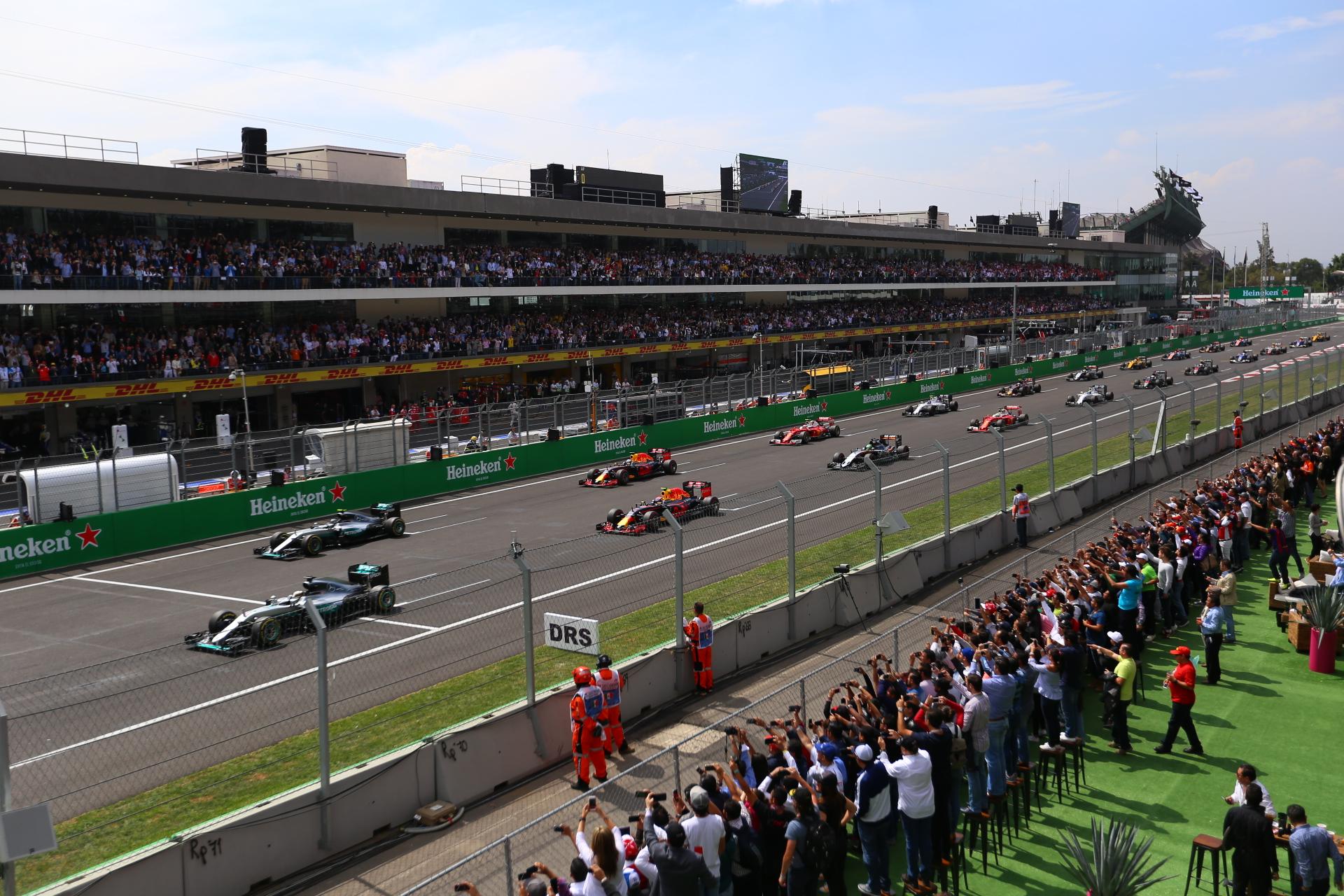
We ran the race 400 times through our engine, starting from the real qualifying grid. This is what came out.
 Leer en español
Favourite
Lewis Hamilton 30.5%
Wins 30.5% of the simulations and finishes on the podium in 72%. Starts P1.
Driver by driver
| Grid | Driver | Win | Podium | Avg. finish |
|---|---|---|---|---|
| P1 | Lewis Hamilton | 30.5% | 72% | P3.2 |
| P2 | George Russell | 27.8% | 69% | P3.2 |
| P3 | Charles Leclerc | 12% | 50% | P4 |
| P4 | Kimi Antonelli | 19.5% | 52.5% | P3.7 |
| P5 | Max Verstappen | 4.5% | 24.8% | P5.1 |
| P6 | Lando Norris | 5.5% | 26.3% | P4.8 |
| P7 | Isack Hadjar | 0% | 0.3% | P8.3 |
| P8 | Arvid Lindblad | 0% | 0% | P10.8 |
| P9 | Pierre Gasly | 0% | 0% | P10.8 |
| P10 | Nico Hulkenberg | 0% | 0% | P13.5 |
| P11 | Franco Colapinto | 0% | 0% | P12.3 |
| P12 | Oscar Piastri | 0.3% | 5.3% | P6.8 |
| P13 | Gabriel Bortoleto | 0% | 0% | P15.4 |
| P14 | Oliver Bearman | 0% | 0% | P14.6 |
| P15 | Carlos Sainz | 0% | 0% | P13.8 |
| P16 | Alexander Albon | 0% | 0% | P15.6 |
| P17 | Fernando Alonso | 0% | 0% | P14.4 |
| P18 | Ryo Hirakawa | 0% | 0% | P17.6 |
| P19 | Lance Stroll | 0% | 0% | P19.4 |
| P20 | Sergio Perez | 0% | 0% | P18.8 |
| P21 | Valtteri Bottas | 0% | 0% | P19.6 |
| P22 | Liam Lawson | 0% | 0% | P15.9 |
Opinion · our reading
Hamilton on pole, Russell alongside and Antonelli fourth: the model splits the win between three
The starting column is the official GRID. Max Verstappen qualified fourth and starts fifth after a one place penalty for colliding with Liam Lawson in second practice, so Kimi Antonelli moves up to fourth. Lawson, who had qualified eighth, was disqualified from qualifying over the MGU-K and starts last with the stewards' permission. Valtteri Bottas had a 50 place penalty for power unit elements, which changes nothing because he was already last.
Lewis Hamilton has his first pole with Ferrari and the model gives him 30.5% of the wins, with George Russell close behind (27.8%) from second. Mexico is one of the tracks where the starting position matters most, so the win stays almost entirely with the front row and with Antonelli (19.5%) and Charles Leclerc (12%). Nobody starting seventh or lower wins a single time in 400 races, apart from Oscar Piastri once, from twelfth.
For the title another column matters: Antonelli finishes in the top ten in 98% of the races. He only fails to become champion on Sunday if Russell or Hamilton wins and he finishes tenth or lower. And a note on Ryo Hirakawa, who makes his debut in Esteban Ocon's Haas: he has no season in our database, so he races with the lowest rating on the 2026 grid. That is our assumption, not a data point.
How the model works
The engine accounts for how much starting at the front is worth at each circuit, and nowhere is it worth as much as at Monaco. Since the 2026 Azerbaijan GP that weight is calibrated track by track against the real races from 2014 to 2025; earlier previews ran on a simpler formula that derived it from how easy it is to overtake on each layout. Which is why Lewis Hamilton comes out favourite at 30.5% without having the fastest car of the season.
A favourite who only wins one race in four is not a broken model: that is what a real Grand Prix looks like. A retirement, a safety car at the wrong moment or a slow stop flips the result, and the engine simulates all of them. That is why 5 drivers have a genuine shot rather than a single name circled in red.
The most interesting column is the average finish: Liam Lawson starts P22 and averages P15.9, the biggest gain on the grid: the driver the model thinks is most underrated by where he qualified.
The numbers come from 400 full race simulations (71 laps) with car and driver ratings updated to this point of the season. This is not betting advice and not an official prediction: it is what our model said. Tomorrow anyone can check whether it was right.