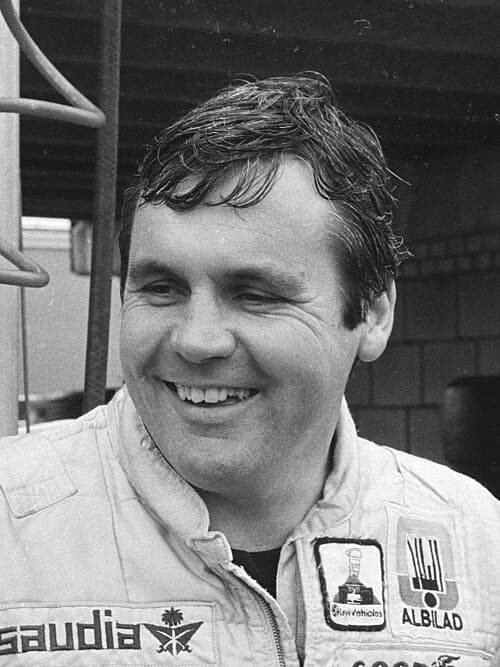

Alan Jones
Australian · 1975-1981, 1983, 1985-1986
Photo: Original: NL-HaNA, ANEFO / neg. stroken, 1945-1989, 2.24.01.05, item number 930-9867 / Derivative work: Danyele · CC0 · Wikimedia Commons
Jones in numbers
199 official points
1Drivers’ titles
1980
18th of 789 all time
2Constructors’ titles
1980, 1981
24th of 789 all time
10.3% of races
5.2% of races
20.7% of races
0Drivers’ titles
none
0Constructors’ titles
none
0Drivers’ titles
none
0Constructors’ titles
none
0Drivers’ titles
none
0Constructors’ titles
none
0Drivers’ titles
none
0Constructors’ titles
none
7.1% of races with Shadow
14.3% of races with Shadow
1Drivers’ titles
1980
of 1 in the career
2Constructors’ titles
1980, 1981
of 2 in the career
18.3% of races with Williams
10% of races with Williams
36.7% of races with Williams
0Drivers’ titles
none
0Constructors’ titles
none
0Drivers’ titles
none
0Constructors’ titles
none
Alan Jones gave Williams its first world championship, in 1980, and he was the first of the seven drivers who would win it with that team. An Australian born in 1946, he made his debut in 1975 and drove for Hesketh, Hill, Surtees and Shadow, with which he won his first race in Austria in 1977 from fourteenth on the grid.
Frank Williams signed him in 1978 and the following year, with the FW07, he won four races in the second half of the season: Germany, Austria, the Netherlands and Canada. In 1980 he was champion with five victories, in a fight decided in Montreal, the second to last race, when Nelson Piquet started from pole and blew his engine. Jones won there and at the final round in Watkins Glen as well, finishing on 67 points to 54. Williams also took the constructors' championship with almost double the runner-up.
In 1981 he finished third and signed off by winning the last race of the year, in Las Vegas. He came back for one race in 1983 with Arrows and again with Lola, four races at the end of 1985 and the whole of 1986, without winning. He retired with 12 victories from 116 Grands Prix.
 Ver en español
Teams
Tags
Best year
1980
What would Alan Jones have achieved with a different car or in a different era?
Related drivers


His team-mates
18 team-mates across 8 seasons. When both finished the race, Jones was ahead in 30 of 42; on the grid he started ahead in 66 of 106.
| Year | Team-mate | In the race | On the grid |
|---|---|---|---|
| 1975 | James HuntHesketh · 4 races | · | 0-4 |
| 1975 | Tony BriseEmbassy Hill · 4 races | 0-2 | 0-4 |
| 1975 | Torsten PalmHesketh · 1 race | · | 1-0 |
| 1976 | Brett LungerSurtees · 9 races | 3-1 | 8-1 |
| 1976 | Henri PescaroloSurtees · 7 races | 3-0 | 7-0 |
| 1976 | Conny AnderssonSurtees · 1 race | · | 1-0 |
| 1976 | Noritake TakaharaSurtees · 1 race | 1-0 | 1-0 |
| 1977 | Riccardo PatreseShadow · 9 races | 2-0 | 6-3 |
| 1977 | Renzo ZorziShadow · 2 races | · | 2-0 |
| 1977 | Jackie OliverShadow · 1 race | 0-1 | 1-0 |
| 1977 | Arturo MerzarioShadow · 1 race | · | 1-0 |
| 1977 | Jean-Pierre JarierShadow · 1 race | · | 1-0 |
| 1979 | Clay RegazzoniWilliams · 15 races | 5-1 | 15-0 |
| 1980 | Carlos ReutemannWilliams · 14 races | 7-2 | 8-6 |
| 1980 | Rupert KeeganWilliams · 4 races | 4-0 | 4-0 |
| 1981 | Carlos ReutemannWilliams · 15 races | 4-4 | 5-10 |
| 1983 | Marc SurerArrows · 1 race | · | 1-0 |
| 1986 | Patrick TambayLola · 15 races | 1-1 | 4-11 |
| 1986 | Eddie CheeverLola · 1 race | · | 0-1 |
The first number is always Jones's. A team-mate is whoever started the same race for the same team. "In the race" only counts races both finished, because a retirement says nothing about who was quicker. "On the grid" is the starting position, with penalties already applied.
Compare Jones with another driver
Titles, wins, poles and podiums side by side, against any of the 789 drivers in history.
Keep reading
Where Alan Jones comes up in what we have measured, with our own numbers.
- 9 min readA dominant car lasts 1.4 seasons, and none has ever kept dominating the year afterWe counted all 18 runs of dominance since 1958, taking dominance to mean winning 60% of a season’s races. They last 1.39 seasons on average, 13 las…
- 6 min readIn the eighties four cars in ten finished. Today more than eight doThe biggest change in Formula 1 is invisible, because it happens in the workshop. Four straight decades below 52% of cars finishing, then a climb t…
- 8 min readKnowing which car a driver joins predicts his season better than knowing who he isA transfer is the closest thing F1 has to an experiment: the driver stays the same and the car changes. We took the 94 team changes since 1988 and…