Austin is the circuit where pole position is least likely to survive lap one
F1 Legend Sim · Redacción · 24 de octubre de 2026 · 4 min de lectura
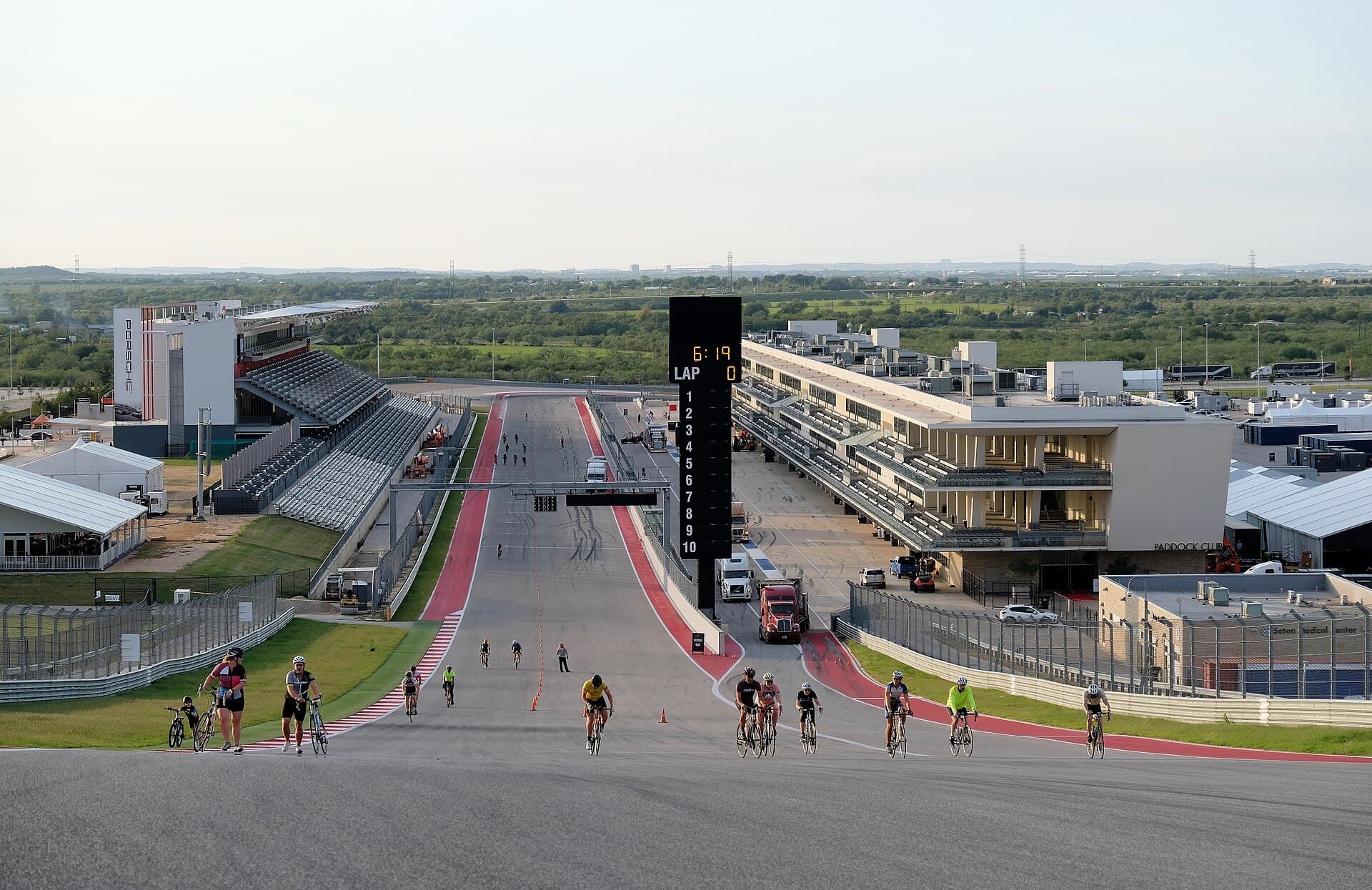
Since Formula 1 started racing at the Circuit of the Americas, the polesitter has lost the lead before the end of the first lap seven times out of thirteen. We compared it with all 291 races held since 2012 and no other track looks like this: everywhere else, the driver who starts first is still first at the end of lap one in three races out of four.
Lap one, year by year
Here is every United States Grand Prix in Austin: who started on pole, who was leading when they crossed the line at the end of lap one, and who went on to win. There was no race in 2020.
| Year | Pole | Leading after lap 1 | Winner |
|---|---|---|---|
| 2012 | Vettel | Vettel | Hamilton (from P2) |
| 2013 | Vettel | Vettel | Vettel (from P1) |
| 2014 | Rosberg | Rosberg | Hamilton (from P2) |
| 2015 | Rosberg | Hamilton (from P2) | Hamilton (from P2) |
| 2016 | Hamilton | Hamilton | Hamilton (from P1) |
| 2017 | Hamilton | Vettel (from P2) | Hamilton (from P1) |
| 2018 | Hamilton | Räikkönen (from P2) | Räikkönen (from P2) |
| 2019 | Bottas | Bottas | Bottas (from P1) |
| 2021 | Verstappen | Hamilton (from P2) | Verstappen (from P1) |
| 2022 | Sainz | Verstappen (from P2) | Verstappen (from P2) |
| 2023 | Leclerc | Norris (from P2) | Verstappen (from P6) |
| 2024 | Norris | Leclerc (from P4) | Leclerc (from P4) |
| 2025 | Verstappen | Verstappen | Verstappen (from P1) |
In six of those seven, the driver who got past was the one starting second. The seventh was Leclerc in 2024, who started fourth and was already in front at the end of the lap. The recent trend is even sharper: from 2021 to 2025, pole survived the first lap only once, Verstappen's last year.
No other circuit comes close
To find out whether that is unusual, we ran the same count at every circuit with at least eight races since 2012, nineteen of them. Austin comes last:
| Circuit | Pole still leads after lap 1 | Races |
|---|---|---|
| Austin | 46% | 6 of 13 |
| Mexico City | 50% | 5 of 10 |
| Barcelona | 57% | 8 of 14 |
| Melbourne | 58% | 7 of 12 |
| Sochi | 62% | 5 of 8 |
| F1 average | 73% | 213 of 291 |
| Montreal | 92% | 11 of 12 |
| Monaco | 92% | 12 of 13 |
At the other end are Monaco and Montreal, where the polesitter is still in front after lap one in more than nine races out of ten. And second on the list is Mexico City, next week's race: of the two Grands Prix left in North America, both are among the worst for pole.
And it shows in who wins
Losing the first corner does not always cost the race: in 2017 and 2021 the polesitter took the lead back and won. But the gap holds in the final result. In Austin, the driver starting second has won five races out of thirteen, 38%, against 24% across F1 since 2012. Only Melbourne and Silverstone hand more wins to the second-place starter. Pole wins in Austin 46% of the time, against 53% elsewhere.
What does not change is that the front row rules: eleven of the thirteen winners started first or second, as we showed in Antonelli's maths for Austin. What makes this circuit different is that, between those two, the advantage of starting first almost disappears.
The simulator gets there on its own
This site's race engine knows nothing about first laps, but it does carry a measure, track by track, of how much the starting position weighs on the result, calibrated against the real races from 2014 to 2025. In that table Austin is 26th out of 30: one of the places where starting in front is worth least. Monaco is first. Two different measurements with different data, pointing the same way.
Why it happens, and what we do not know
The usual explanation is turn 1 itself: a long straight that ends in a very steep climb to a left-hand hairpin with a very wide entry. The driver starting second arrives in the slipstream of the first and can pick his line, while the polesitter has to defend the inside uphill. Our data does not measure that; it only says who was in front at the end of the lap. The explanation fits, but it is an explanation, not a number.
It also needs reading with care: thirteen races is a small sample, and 2026 brings new cars. Pole not lasting in Austin is what has happened for thirteen years, not a law.
For Sunday
If the polesitter does not win on Sunday, it will not be a surprise: it is what usually happens at this circuit. With the official grid we will publish the preview with every driver's chances in the Grand Prix panel, and if you want to make your own call, in Predict the GP you put the top ten in order before the race. Every winner of the United States Grand Prix, including Watkins Glen and Indianapolis, is in its history.