Driver career · free in your browser
The Racing Line: an F1 career game from karting to Formula 1
Build a racing driver from nothing and see how far the talent and the decisions take you. No download and no account needed to play: it runs in the browser, on a phone or a computer.
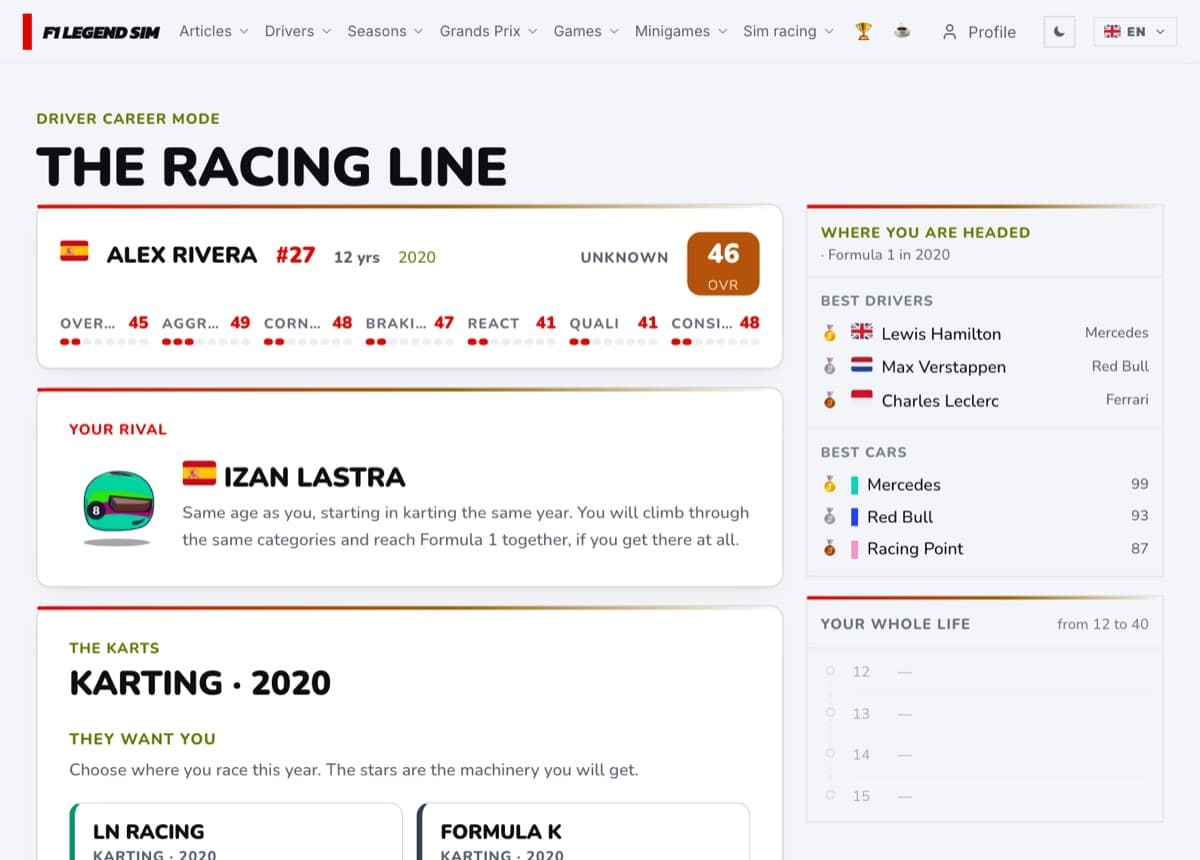
From karting to Formula 1
You start at twelve in a kart and work your way through F4, F3 and F2. Every season is a choice between offers from real junior teams, and the seat you take shapes how far you can go.
Real grids, real eras
Retro mode lets you pick the era: the Formula 1 waiting for you is the real grid of that year, with the drivers and cars that raced it. Your F1 seasons are run by the same simulation engine as the rest of the site.
A market that can drop you
Contracts last one to three years, team-mates fight you for number-one status and legends come back from retirement. Your debut is guaranteed, the second contract is not.
A new challenge every week
Each week brings a named scenario with its own starting point, and every run goes on the leaderboard: today, this week, all time and by country.
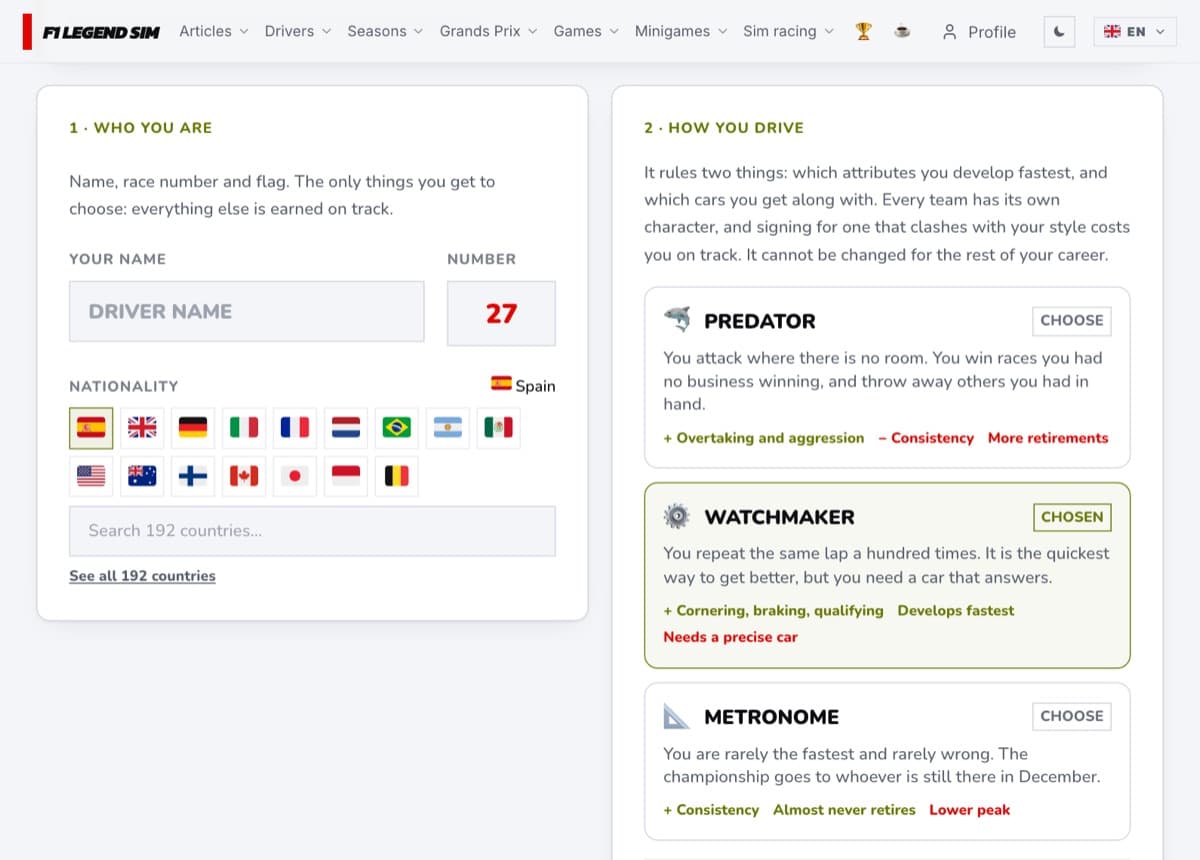
What The Racing Line is
A driver career that starts at twelve in a kart and ends, with luck, in Formula 1. The F1 seasons are not scripted: they are run by the same simulation engine as the rest of the site, against the real grid of whatever year you are in.
- 40
- years old, when the career ends
- 20
- F1 seasons on average, if you get there
- 5%
- of runs never win a single race
You climb the ladder, you do not skip it
Reaching Formula 1 means having raced F4, F3 and F2. There is no shortcut by age or by talent: get the junior categories right and you arrive with room to spare, waste them and you arrive late or not at all. Every winter the world ages around you, the drivers ahead of you retire and seats rotate, so the window for your jump opens and closes on its own.
Your F1 debut is guaranteed, but only the first one. If nobody has met your standard, the worst car on the grid signs you. The reward for doing well is not getting in: it is which car you get in with. From the second year onwards the market can leave you out.
Decisions move your ceiling, not your stats
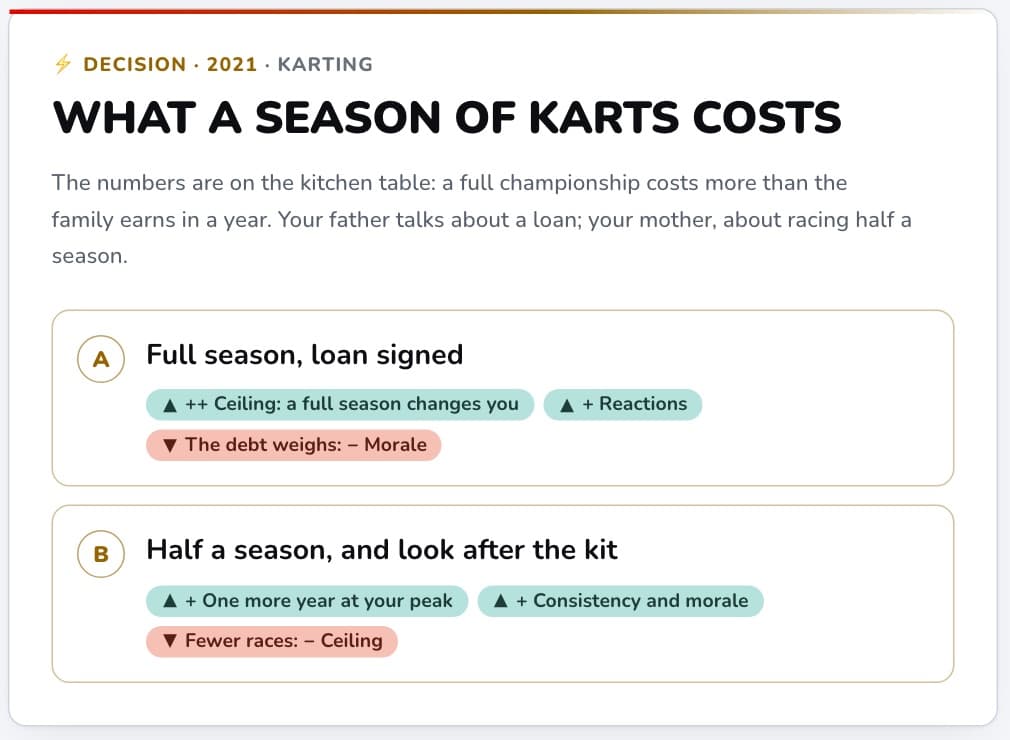
In the junior categories every season brings a dilemma with two or three ways out, and what is at stake is almost never a single stat. It has been measured over five hundred careers: gifting three points to one attribute ends up worth about seventy points of outcome, because yearly growth pushes you towards your limit anyway and eats the gift. What really decides a career is how far you can go and at what age you peak, and that is worth five times more.
That is why each option says what it moves. What is never shown is the number of your ceiling, and that is a design decision rather than an oversight: it was tried twice and removed twice. Seeing a low ceiling at twelve invites restarting until the roll is good, and a mode you restart until the roll is good is a slot machine.
How hard it is
The spread is measured over two hundred runs played the way people play, taking the highest rated car on offer and the option that looks best in each dilemma. Twenty-eight in a hundred end without a single title and thirty-two land between one and three; the other forty win four or more. It stands out next to another figure from the same batch: only 5% of careers end without a single race win. Winning Sundays is common, winning championships is not.
A career ends at forty. There is no roll and no random cutoff: the date is the same for everyone, known from the start, and flagged before it arrives. Random cutoffs were tried and two identical runs ended in different years with no way for the player to know why, which is the worst way to end a story. Running to forty leaves room for about twenty Formula 1 seasons, and enough time for the decline of the final years to actually show.
What the model cannot do
Worth saying because it changes how to read a result. The engine has no wet-weather attribute: when it rains it only changes the weight it gives to each thing, and approximates talent in the wet using reflexes. That means it cannot reproduce the drivers whose reputation was built in the rain, and that a wet race says less than it appears to. Reliability, for its part, weighs so little in the retirement formula that the result barely moves between a very reliable car and a mediocre one.
The weekly challenge
On top of the free run there is a weekly challenge with a fixed seed: everyone plays the same era, the same generated world and the same rival, and careers are compared in a table split by day, week, all time and country. It changes every Monday. There is also a retro mode where you pick the decade, and then the Formula 1 waiting for you at the top is the real grid of that year.
Frequently asked questions
- Is The Racing Line free?
- Yes. It is free and you do not need an account to play. Signing in with Google only keeps your runs in your profile.
- Do I drive the car?
- No. It is a career game, not a driving game: you make the decisions (teams, contracts, dilemmas) and every Formula 1 season is run by a simulation engine against the real grid.
- Can I play it on my phone?
- Yes. It runs in the browser on a phone, a tablet or a computer, with nothing to download or install.
- Which years can I race in?
- The Formula 1 grids are the real ones from 1988 to 2026, and retro mode lets you start your career in the eighties, the nineties, the 2000s, the hybrid era or today. After 2026 the world keeps going with generated drivers and teams.
- How long does a career last?
- Until you turn forty, the same for everyone and announced from the start. If you reach Formula 1, that leaves room for about twenty seasons.
Twelve years old, a kart and a long way to Formula 1.
Start your career →Keep reading
What the simulator says about what you have just played, measured over thousands of seasons.
- 8 min readTalent or car? We simulated 2,000 driver careers to find outTwo thousand complete careers, from karting to retirement, measured one by one. Junior titles barely predict anything; the car decides almost every…
- 7 min readWhat age is a Formula 1 driver at their best? The curve and its trapFifteen hundred careers measured by age. The chart says drivers keep improving until 36, and it lies: between 28 and 30, 74% of the grid disappears…
- 8 min readHow much is the car worth, and how much the driver? 600 simulated seasonsWe put Schumacher, Alonso, Hamilton and Verstappen in the worst car on their own grid, and the slowest driver in the best one. 11,400 races later:…