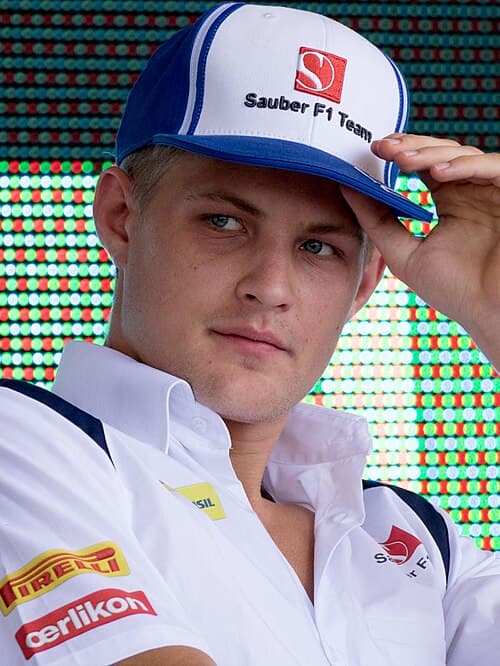

Ericsson in numbers
18 official points · best championship finish: 17th in 2018
0Drivers’ titles
none
0Constructors’ titles
none
0Drivers’ titles
none
0Constructors’ titles
none
0Drivers’ titles
none
0Constructors’ titles
none
Marcus Ericsson spent five seasons in Formula 1 in cars from the back of the field and later found in the United States the win that never came here. A Swede born in 1990, he made his debut in 2014 with Caterham and was the first Swedish driver in an F1 race since Stefan Johansson in 1991. The team went into administration before the end of the season and he never raced for it again.
In 2015 he moved to Sauber, where he stayed for four years. In his first race with the team, in Australia, he finished eighth, and he ended the season with nine points. The next two were blank, in a Sauber that ran at the back of the grid.
In 2018, with Charles Leclerc as his team-mate, he scored nine points again, spread across six races, and in Brazil he started sixth, the best grid position of his career. For 2019 the team chose Kimi Räikkönen and Antonio Giovinazzi, and Ericsson left for IndyCar.
There he won the Indianapolis 500 in 2022. In F1 he stopped at eighteen points in five seasons.
What if Ericsson had another car?
We took his real attributes and put him in the best car of each era: in a real driver's seat, against the team-mate that car actually had. 30 full seasons in each.
| Car | Team-mate | Finish | Wins | Titles |
|---|---|---|---|---|
| McLaren1988 | Alain Prost-193 pts | P2.9 | 0.3 | 0% |
| Williams1992 | Riccardo Patrese-149 pts | P5.2 | 0.2 | 0% |
| Ferrari2002 | Rubens Barrichello-188 pts | P4.5 | 0.7 | 0% |
| Red Bull2013 | Mark Webber-196 pts | P4.1 | 0.8 | 0% |
| Mercedes2016 | Lewis Hamilton-232 pts | P3.8 | 0.3 | 0% |
| Red Bull2023 | Sergio Perez-170 pts | P2 | 2 | 0% |
| Cadillac2026 · 11th on the grid | Valtteri Bottas-8 pts | P15.5 | 0 | 0% |
The only one who beats him is Lewis Hamilton in the 2016 Mercedes: 232 points clear over a full season.
 Ver en español
Rating by season
- First season
- 60 2014
- Peak
- 63 2015
- 2018
- 63 Sauber
5 seasons in the database, from 2014 to 2018. Our own rating, from 50 to 99.
Teams
Tags
Best year
2018
What would Marcus Ericsson have achieved with a different car or in a different era?
Related drivers


His team-mates
6 team-mates across 5 seasons. When both finished the race, Ericsson was ahead in 23 of 55; on the grid he started ahead in 39 of 96.
| Year | Team-mate | In the race | On the grid |
|---|---|---|---|
| 2014 | Kamui KobayashiCaterham · 15 races | 2-5 | 5-10 |
| 2014 | André LottererCaterham · 1 race | · | 0-1 |
| 2015 | Felipe NasrSauber · 19 races | 5-8 | 10-9 |
| 2016 | Felipe NasrSauber · 21 races | 9-4 | 11-9 |
| 2017 | Pascal WehrleinSauber · 18 races | 4-6 | 7-11 |
| 2017 | Antonio GiovinazziSauber · 2 races | · | 2-0 |
| 2018 | Charles LeclercSauber · 21 races | 3-9 | 4-17 |
The first number is always Ericsson's. A team-mate is whoever started the same race for the same team. "In the race" only counts races both finished, because a retirement says nothing about who was quicker. "On the grid" is the starting position, with penalties already applied.
Compare Ericsson with another driver
Titles, wins, poles and podiums side by side, against any of the 789 drivers in history.
Keep reading
Where Marcus Ericsson comes up in what we have measured, with our own numbers.
- 9 min readTwelve teammate duels, in exactly the same carSenna against Prost, Alonso against Hamilton, Hamilton against Rosberg: twelve real pairings, five seasons each, machinery exactly equalised. The m…
- 7 min readWhat age is a Formula 1 driver at their best? The curve and its trapFifteen hundred careers measured by age. The chart says drivers keep improving until 36, and it lies: between 28 and 30, 74% of the grid disappears…
- 8 min readKnowing which car a driver joins predicts his season better than knowing who he isA transfer is the closest thing F1 has to an experiment: the driver stays the same and the car changes. We took the 94 team changes since 1988 and…